


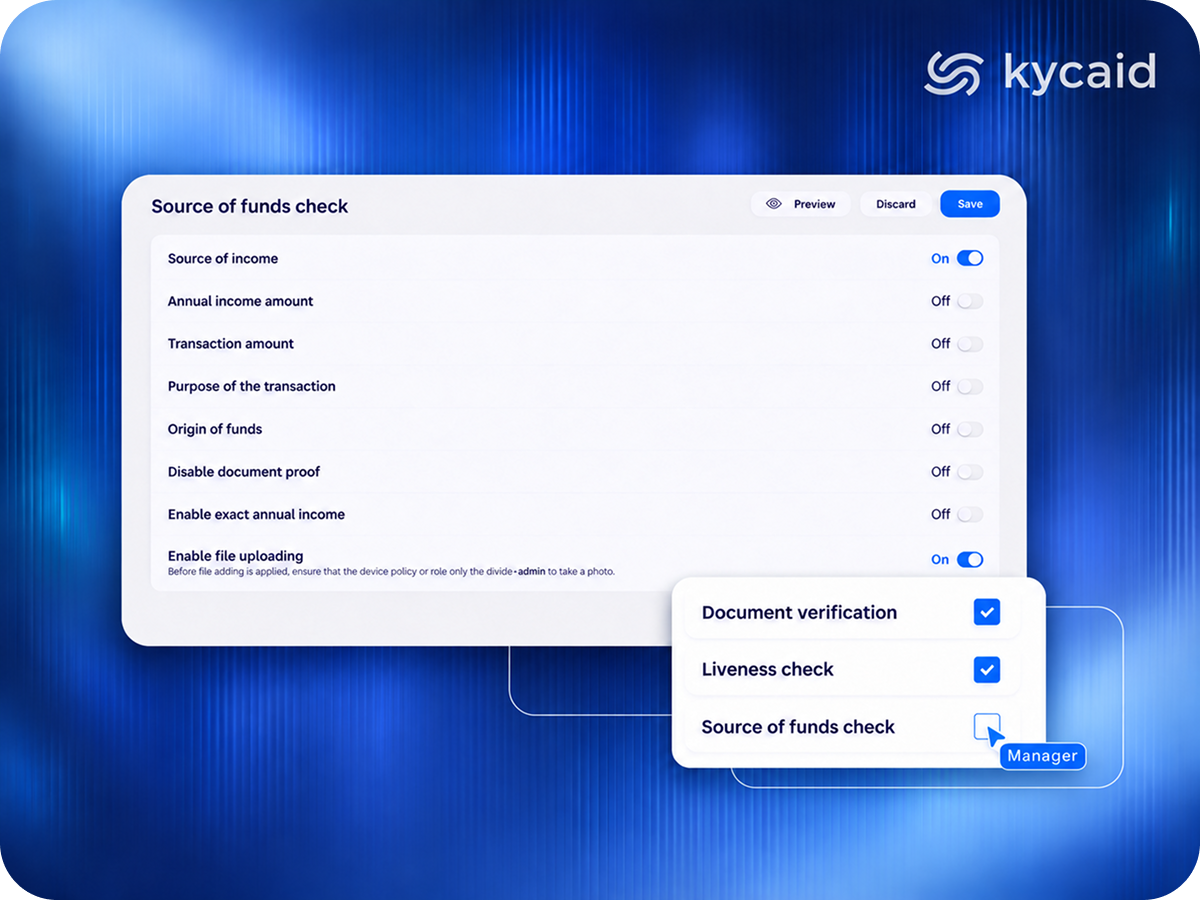
The same compliance core, a different amount of work
Both platforms cover KYC, AML, KYB and crypto compliance for the same fintech, iGaming and crypto teams. The difference shows up in how much you build before going live, how the hard cases are handled, which features sit behind a higher plan, and what you pay when your volume is low. Compare both, line by line.
Trusted by 100+ regulated businesses across fintech, iGaming and crypto








Coverage is not where they differ
Both platforms cover the compliance core — identity verification, AML screening, business verification and crypto checks — for the same fintech, iGaming and crypto teams. Coverage is close: Sumsub publishes 220+ countries and territories and 14,000+ documents; KYCAID covers 240+ countries and territories and 14,000+ document types.
The difference is how much you build before going live and what sits in which plan. Sumsub gives your team a no-code Workflow Builder to own; business verification, database checks and Travel Rule sit in their Enterprise plan. KYCAID ships pre-built verification flows, adds a self-guided Video Quiz and government database checks for the cases automation rejects, and prices per verification with no monthly minimum.
What each platform includes
Marks reflect public vendor materials as of 9 November 2026. Descriptions are written from KYCAID's side.
| Feature | KYCAID | Sumsub |
|---|---|---|
Self-guided Video Quiz Sumsub does not offer a self-guided video route. With KYCAID, the user records a short verification video on their own time — no agent scheduled, no queue — which gives you a way through the cases automated checks reject for innocent reasons. | Yes | No |
Live agent video call Both platforms have it. On Sumsub, the route may need enabling through a Customer Success Manager; with KYCAID, it is part of the standard flow for the cases you want a human to close. | Yes | Yesmay need enabling via CSM |
Non-documentary government database checks Sumsub offers this in supported jurisdictions, on its Enterprise plan. With KYCAID, it is part of the standard flow: personal data is checked against a government database directly in about 2 seconds, answering what a photographed document leaves open. | Yes | YesEnterprise plan |
No-code workflow builder Both platforms have a no-code workflow builder. Sumsub's is where your team builds the flow from the ground up. With KYCAID you can start from ready-made form templates and go live the same day, or open the workflow builder and shape the flow around your own risk policy. | Yes | Yes |
Transaction monitoring rule builder Both platforms have configurable transaction rules; on Sumsub, AML screening and ongoing monitoring start at the Compliance plan. With KYCAID, the rule builder, crypto wallet checks and crypto transaction AML screening sit in the core platform — there is no plan tier to move up to. | Yes | Yesfrom the Compliance plan |
Travel Rule Travel Rule compliance runs through Travel Rule Protocol, a platform we built specifically for that obligation rather than bolting it onto KYC. Sumsub includes Travel Rule in its own stack, on its Enterprise plan. | Yesvia Travel Rule Protocol | YesEnterprise plan |
Sumsub does not offer a self-guided video route. With KYCAID, the user records a short verification video on their own time — no agent scheduled, no queue — which gives you a way through the cases automated checks reject for innocent reasons.
Both platforms have it. On Sumsub, the route may need enabling through a Customer Success Manager; with KYCAID, it is part of the standard flow for the cases you want a human to close.
Sumsub offers this in supported jurisdictions, on its Enterprise plan. With KYCAID, it is part of the standard flow: personal data is checked against a government database directly in about 2 seconds, answering what a photographed document leaves open.
Both platforms have a no-code workflow builder. Sumsub's is where your team builds the flow from the ground up. With KYCAID you can start from ready-made form templates and go live the same day, or open the workflow builder and shape the flow around your own risk policy.
Both platforms have configurable transaction rules; on Sumsub, AML screening and ongoing monitoring start at the Compliance plan. With KYCAID, the rule builder, crypto wallet checks and crypto transaction AML screening sit in the core platform — there is no plan tier to move up to.
Travel Rule compliance runs through Travel Rule Protocol, a platform we built specifically for that obligation rather than bolting it onto KYC. Sumsub includes Travel Rule in its own stack, on its Enterprise plan.
Plan names and feature availability are as published by each vendor. Sumsub is a trademark of its owner; KYCAID is not affiliated with or endorsed by Sumsub.
The numbers, side by side
Only figures both vendors publish. Where a vendor does not state a number, the cell says so rather than guessing.
| KYCAID | Sumsub | |
|---|---|---|
| Countries and territories | 240+ | 220+ |
| Document types recognised | 14,000+ identity document types | 14,000+ identity and address documents |
| Published price per check | From EUR 0.25 per liveness check, EUR 0.50 per document check | $1.35 on Basic ($149 monthly minimum); $1.85 on Compliance ($299 minimum) |
| Monthly minimum | None | $149; $299 on the Compliance plan |
| Subscription required | No | Plan-based |
| Trial | €50 welcome credit, full platform, no time limit | 14-day trial, 50 free checks |
| Support included at entry level | 24/7, every customer | Not published |
Sumsub figures as published on Sumsub’s own pricing page and documentation, checked 9 November 2026. Sumsub’s 220+ countries and 14,000+ documents are its own published figures. Rates are shown in the currency each vendor publishes them in, without conversion. Figures change — confirm both vendors’ terms in writing before you sign.
Sumsub figures as published on Sumsub’s own pricing page and documentation, checked 9 November 2026. Sumsub’s 220+ countries and 14,000+ documents are its own published figures. Rates are shown in the currency each vendor publishes them in, without conversion. Figures change — confirm both vendors’ terms in writing before you sign.
Where the platforms differ
- Sumsub's no-code Workflow Builder gives your team wide control over its own verification logic. Someone on your side then owns those flows, tests them and updates them as rules change.
- With KYCAID you have both routes. Start from a ready-made form template that matches your user types and risk levels, connect through one API, and most customers run their first live verification the same day. When your rules change or you need a flow of your own, the workflow builder lets your team adjust it without code.
- The difference is where you start. With Sumsub you build the flow before you can go live. With KYCAID you go live on a template and build only what you need to change.
- Every compliance team knows the customer who fails automated checks for innocent reasons: a worn passport, bad lighting, a name transliterated three different ways. KYCAID gives you two video routes for those cases, a live agent call or a self-guided Video Quiz the user records on their own time.
- KYCAID also checks personal data against government databases directly, in about 2 seconds, which answers questions a photographed document leaves open.
- Sumsub offers video identification as well, plus non-documentary verification in supported jurisdictions. Its live agent route may need enabling through a Customer Success Manager, so ask how that works at your volume before you decide.
- For a crypto business, KYC without transaction monitoring only covers part of the obligation. KYCAID includes a rule builder that runs configurable checks on transactions, plus crypto wallet checks and crypto transaction AML screening in the core platform. Travel Rule compliance is handled by our dedicated platform, Travel Rule Protocol (TRP), rather than bundled into KYCAID — keeping each product focused on what it does best.
- Sumsub covers similar ground for crypto, Travel Rule included, and publishes its capabilities openly.
- Where the two differ is how the cost is structured. Pricing across KYCAID and TRP is transparent and itemised. Ask both vendors to quote transaction monitoring and Travel Rule as separate lines, then compare at your expected volume — that is where the difference shows up.
- Sumsub publishes its pricing: $1.35 per verification with a $149 monthly minimum on Basic, and $1.85 per verification with a $299 monthly minimum on Compliance — the plan where AML screening and ongoing monitoring start. If you need monitoring, that second pair is your comparison, not the entry rate. Published rates make budgeting easier, though the minimum applies regardless of whether you reach it.
- KYCAID publishes transparent per-verification pricing too, with no monthly minimum and no subscription — you pay only for the checks you actually run, and start with a €50 welcome credit to test the full platform before committing. Support comes with the contract rather than being gated behind a higher tier.
- Ask both vendors the same two questions before you sign. What does our exact mix of checks cost at our expected volume, and what does support cover once we are live.
Which one should you choose
Choose Sumsub if
You have compliance staff who want to own verification logic themselves and have time to maintain it. The no-code Workflow Builder gives them that control, Travel Rule sits in the same stack, and published per-check rates make budgeting predictable.
Choose KYCAID if
You want to go live fast without giving up control: start from ready-made form templates, adjust them or build your own flow in the workflow builder, and connect through one API. You also get a self-guided Video Quiz and ~2-second government database checks for cases automation rejects, no monthly minimum, and support included with every contract.
FAQs
KYCAID is a direct alternative to Sumsub for KYC, AML, KYB and crypto compliance, covering 240+ countries and territories with a basic check in about 11 seconds. The difference between the two is not feature count — it is how much you build before going live. Sumsub gives your team a no-code Workflow Builder and expects someone on your side to own the verification logic. KYCAID ships pre-built flows instead, so most customers are live the same day, and a self-guided Video Quiz covers the verifications that need a video step.
Both cover the compliance core, so start with the numbers. As of 2026, the two are closely matched on coverage — KYCAID publishes 240+ countries and territories, Sumsub 220+, and both recognise 14,000+ document types. The difference shows up elsewhere. Sumsub publishes per-check pricing starting at $1.35, with tiered plans and a monthly minimum; AML screening and ongoing monitoring start at its Compliance plan, and Non-Doc Verification, Database Validation, Business Verification and Travel Rule sit on the Enterprise plan. KYCAID offers transparent per-verification pricing with no monthly minimum, adds a self-guided Video Quiz and non-doc government database checks, and includes 24/7 support for every customer through group chats — faster than email — with a fallback to a dedicated manager for difficult cases.
Companies evaluating Sumsub usually shortlist KYCAID, Veriff, Onfido (now part of Entrust), Jumio, Trulioo, Persona and ComplyCube. Which of them fits depends on your industry, markets and volume, and no vendor page can settle that for you. Our compare hub links to each head-to-head so you can check the claims yourself.
Yes. Migration runs through the KYCAID API, and the KYCAID team maps your existing verification levels onto KYCAID flows. The part worth planning carefully is your re-verification calendar, so that no customer gets checked twice for no reason. Ask for a migration plan when you book the demo; it is a routine request.
Days rather than months for most customers. Everything runs through one API and Forms. Additionally, the KYCAID team helps to configure verification flows by user type and risk level, so your developers integrate once instead of assembling a toolkit.
Yes, and for a regulated business that is usually the sensible way to switch. Route a slice of new onboarding through KYCAID, watch pass rates and manual review load for a few weeks, then move the rest once your compliance team prefers the numbers.
KYCAID supports KYC, AML and KYB obligations across 240+ countries and territories. KYCAID is certified to ISO/IEC 27001 for information security, and customer data is handled under GDPR and UK GDPR; the operating entity, Compligate LTD, is registered with the UK’s ICO under ZB680338, and verification data is stored encrypted on servers in Belgium, with verification and consent records retained for audits. Regulatory scope is the one area where you should not take any marketing page at its word, including this one. Put your licences and jurisdictions in front of both vendors and ask for the answer in writing.
Sumsub publishes $1.35 per verification with a $149 monthly minimum on its Basic plan, and $1.85 with a $299 minimum on its Compliance plan, which is where AML screening and ongoing monitoring start — as published on Sumsub’s pricing page in November 2026. So if you need monitoring, the rate to compare against is $1.85, not the entry price. Published rates make budgeting easier, but the minimum commitment applies whether you reach it or not. KYCAID also publishes transparent per-verification pricing, with no monthly minimum and no subscription — you pay only for the checks you run, priced to your volume and mix, and start with a €50 welcome credit to test the full platform first. Put both vendors’ rates next to each other for your expected volume and the difference tends to show up in the minimums.
Yes. KYCAID covers crypto compliance in the core platform: a configurable rule builder that runs transaction monitoring, crypto wallet verification, and crypto transaction AML screening. Travel Rule compliance is handled by our dedicated platform, Travel Rule Protocol (TRP), rather than bundled into KYCAID — a purpose-built product for that obligation. Sumsub covers similar ground with Travel Rule included in its own stack, so for crypto the comparison usually comes down to price and how each solution is structured. Ask both vendors to itemise transaction monitoring and Travel Rule before you compare totals.
Put both quotes side by side
Start with a €50 welcome credit, run your own mix of checks, and pay no monthly minimum while you evaluate.
Last reviewed: 9 November 2026. Sumsub figures are as published by Sumsub on its own pricing and documentation pages; plan contents reflect its published plans. Sumsub is a trademark of its owner. KYCAID is not affiliated with or endorsed by Sumsub. Figures change — confirm both vendors’ terms in writing before you sign.