
A customer wants to deposit €200,000. The compliance team can ask two questions. Where did this money come from? And how did this person come to have money like this at all?
The first question is about source of funds. The second is about source of wealth. Regulators treat them as different checks, and expect firms to know which one they are running and when they need both.
Short answer. Source of funds (SoF) is the origin of the money in a specific transaction, such as a salary or a property sale. Source of wealth (SoW) is how a customer built their total net worth, such as through a career, a business or an inheritance. AML (anti-money laundering) rules require a source of funds check for higher-risk transactions. Politically exposed persons (PEPs), meaning senior public officials and their families, need both checks. So do other cases that call for enhanced due diligence (EDD), the extra scrutiny for high-risk customers.
What is source of funds?
Source of funds is the origin of the particular money involved in a transaction or a business relationship. The question is narrow: where did these specific funds come from, and how did they reach us?
Examples: a salary that funds a deposit, money from selling a car, a bank loan, or a crypto sale paid out to a bank account. In practice, the evidence usually comes from the transaction trail. That means a bank statement showing the money arriving, and a document explaining why it arrived.
What is source of wealth?
Source of wealth is how a customer built everything they own, not just the money in front of you. Here the question is broader: does this person's total wealth make sense given their life and career?
Think of 20 years as a surgeon, the sale of a company, an inheritance, a property portfolio or early investment in a startup. The evidence is often a mix of documents and public information: tax returns, company filings, sale contracts, probate records and press coverage.
HMRC, the UK tax authority, draws the same line between the two in its anti-money laundering supervision handbook. So does AUSTRAC, Australia's financial intelligence agency.
Source of funds vs source of wealth at a glance
Source of funds asks where this money came from. Source of wealth asks how this person became wealthy.
Source of funds covers one transaction or relationship and looks at the recent path of these funds. Source of wealth covers the customer's total net worth, which often took years or decades to build.
Typical evidence for source of funds is bank statements, payslips or a sale contract. For source of wealth, it is tax returns, company records, probate documents and property registers.
Source of funds is required for higher-risk transactions, in EDD and in ongoing monitoring. Source of wealth is required for PEPs, high-net-worth clients, customers linked to high-risk third countries and in EDD.
For example, a €200,000 deposit from the sale of an apartment is a source of funds question. A logistics business built over 15 years and sold in 2024 is a source of wealth answer.
The two checks support each other. A plausible source of wealth makes a large source of funds credible. If the customer's wealth cannot explain the source of funds, that is a red flag.
When the rules require each one
The rules below come from FATF, the global anti-money laundering standard-setter, and from the EU, the UK and the US. The UK rules are the Money Laundering Regulations 2017 (MLR 2017). "Both" means source of funds and source of wealth. Each rule cites the primary text. Check the version in force in your jurisdiction, because national rules can go further.
FATF. Recommendation 10(d) requires ongoing due diligence on every customer: firms review transactions and, where necessary, the source of funds. Under Recommendation 12(c), firms must take reasonable measures to establish both for foreign PEPs, for domestic PEPs in higher-risk relationships, and for their family members and close associates.
EU, current rules. Under Directive (EU) 2015/849, firms must take adequate measures to establish both for PEPs (Art. 20(b)(ii)). For relationships or transactions involving high-risk third countries, they must get information on both, for the customer and the beneficial owners (Art. 18a(1)(c)).
EU, from July 10, 2027. Under Regulation (EU) 2024/1624 (AMLR), firms may get more information on both, for the customer and the beneficial owners, in higher-risk cases in general (Art. 34(4)(c)). For persons from high-risk third countries, they must apply the enhanced measures listed in Article 34(4) (Art. 29(4)). For PEPs, including occasional transactions, they must take adequate measures to establish both (Art. 42(1)(b)).
UK. Firms must take adequate measures to establish both for PEPs, their family members and known close associates (MLR 2017, reg. 35(5)(b)). For customers or transaction parties established in a country on the FATF "call for action" list, they must get information on both, for the customer and the beneficial owner (MLR 2017, reg. 33(3A)(c)).
US. For private banking accounts of $1 million or more held for non-US persons, firms must find out the source of deposited funds (31 CFR 1010.620(b)(3)).
The pattern is consistent: source of funds is the routine check, and source of wealth is added in higher-risk cases such as PEPs and high-risk countries. None of these rules asks for source of wealth on its own.
Beneficial owners are the people who ultimately own or control a customer. The AMLR applies from July 10, 2027, and from July 10, 2029, for football agents and professional football clubs. Until then, EU firms follow their own country’s AML law, which implements the EU AML directives.
Which documents prove which source
The right document depends on where the money came from. The evidence below combines guidance from the Isle of Man Financial Services Authority (FSA), AUSTRAC and HMRC.
Employment and business. For a salary or bonus, recent payslips, an employment contract, an employer letter and bank statements showing the payments usually work. For the sale of a business, use the sale and purchase agreement, company registry records and a letter from the lawyer who handled the sale.
Property, inheritance and pensions. For the sale of property, ask for the sale contract, the completion (closing) statement, a letter from the lawyer or notary, or a property registry extract. For an inheritance, use the will, the grant of probate (court approval of the will), estate accounts or a letter from the executor or lawyer. For a pension, ask for a pension statement or pension release documents.
Investments and other income. Investments and dividends are shown by brokerage or investment statements, dividend statements and tax returns. Rental income is shown by lease agreements, bank statements and tax returns. Crypto gains need exchange statements, wallet history linked to the customer, tax filings or a blockchain analytics report. Gambling winnings need operator statements showing deposits, bets and withdrawals.
Gifts and loans. Ask for a gift letter or loan agreement, plus the giver's or lender's own source of funds.
Regulators' guidance adds two rules of thumb. A bank statement showing a deposit proves the money arrived, not where it came from. And as a last resort, some regulators accept a signed declaration, but only alongside other information that makes it plausible.
Red flags in source of funds and source of wealth evidence
The same warning signs come up again and again in regulators' guidance:
•Activity that does not fit what you know about the customer: age, job, declared income.
•Transactions that are complex, much larger than usual, or follow an odd pattern.
•Discrepancies between what the customer says and what documents or public sources show.
•Funds routed through a high-risk country or through several accounts for no clear reason.
•Large private funding, gifts or loans that the customer's profile does not explain.
•A customer who will not explain the source of their wealth when asked. The Isle of Man FSA notes that a refusal can itself be an indicator.
Picture a 23-year-old with a student account who deposits €150,000 and calls it a gift from a friend. That one deposit trips three of the flags above.
Related patterns in our glossary: money mules and transaction laundering.
How it differs by industry
Crypto. Funds may have passed through several wallets and exchanges. Source of funds evidence often means exchange statements and a blockchain analytics report showing the path. See crypto KYC.
iGaming. Operators run source of funds checks when deposits exceed a customer's expected profile. In Great Britain, the Gambling Commission's customer interaction guidance treats an AML source of funds check as a moment to interact with the customer. If the check reveals financial difficulty, the operator should review whether the customer is vulnerable to gambling harm. See KYC for gambling.
Real estate and law firms. Transactions are large and infrequent, and the firm often does not know the buyer. Source of funds for the purchase price is standard; source of wealth matters when the buyer is a PEP or the amount does not fit their profile. See real estate and law firms.
Private banking and wealth management. Source of wealth is central to onboarding here. The Wolfsberg Group, an association of large international banks, publishes FAQs on source of wealth and source of funds (2020), and they are the industry reference.
For product teams: how to ask without losing the customer
A source of funds request is the moment many good customers leave. Usually the request feels like an accusation or a dead end. Four things help:
1.Explain why. "Because this deposit is above €X, regulations require us to confirm where the funds came from" lands better than a blank upload field.
2.Ask with a questionnaire first. A short form ("Where did these funds come from?" with options) tells you which document to request, so you do not ask for everything. KYCAID supports custom questionnaires for this.
3.Ask for the minimum. Request only the document that matches the declared source.
4.Set thresholds in advance. Customers accept checks better when the rule is consistent. Agree with compliance which amounts and risk levels trigger a request.
How to verify and document the decision
Collecting documents is half the job. The other half is a record that shows a reviewer what you checked and why you decided as you did.
A defensible record includes:
•The customer's declared source of funds and, where required, source of wealth.
•The documents received, and what each one shows.
•Whether the documents back up the declaration: amounts, dates and names match.
•Any discrepancies and how you resolved them.
•The decision, who made it and when; for PEPs, the senior management approval.
Keep the record with the customer file for as long as your record-keeping rules require. In the UK and EU that is generally five years after the relationship ends or an occasional transaction is completed, and national law can require longer.
When the paper trail is thin
Everything above assumes the documents exist. Cash-heavy economies, informal work, older inheritances and cross-border family wealth often leave thin paper trails. Here regulators do not expect an automatic rejection for a missing document.
They expect a risk-based judgment instead: is the story plausible, can other sources confirm it, and is the remaining risk acceptable? A trained person should make that call.
How KYCAID runs source of funds checks
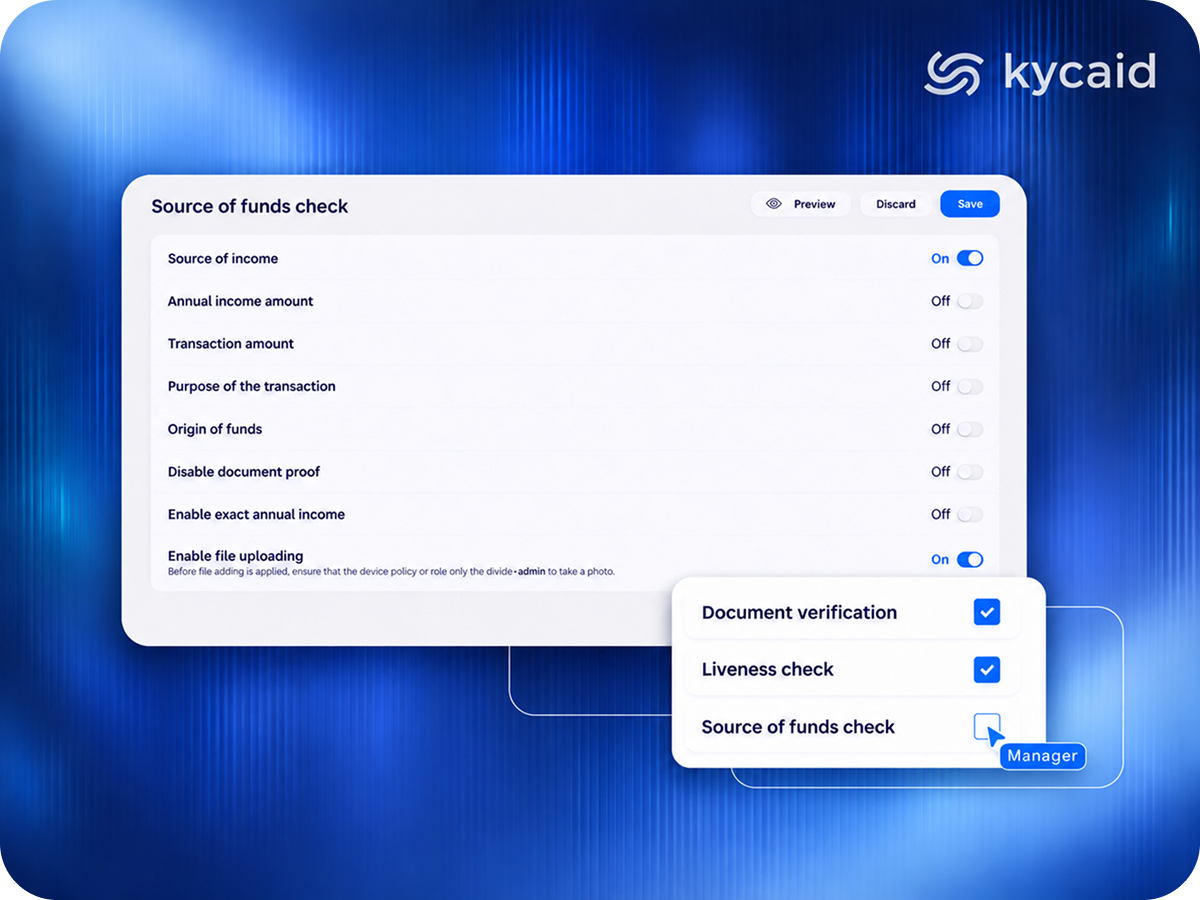
KYCAID's source of funds verification runs in two steps. The customer first verifies their identity. Then they fill in a short form on the origin and amount of the funds and upload a supporting financial document, such as a bank statement. Automated checks and a manual review assess the documents against AML requirements. KYCAID returns the result by callback, a webhook to your system. Standard cases are processed within a 15-minute SLA; complex enhanced due diligence cases can take longer. You configure the step in the source of funds form settings and can trigger it only for customers above your thresholds.
FAQ
🔹What does source of funds mean?
Source of funds means the origin of the specific money used in a transaction or business relationship, such as a salary, a property sale or a loan. Firms check it to confirm the funds are legitimate.
🔹Is source of funds the same as source of wealth?
Source of funds is a different check from source of wealth. Source of funds covers the money in one transaction; source of wealth covers how the customer built their total net worth.
🔹What documents can prove source of funds?
Bank statements, payslips, sale contracts, probate documents, investment statements and loan agreements can all prove source of funds. The right one depends on where the money came from.
🔹When is source of wealth required?
FATF, EU and UK rules require a source of wealth check for politically exposed persons. It is also required in other enhanced due diligence cases, such as customers linked to high-risk third countries.
🔹How far back should a source of wealth check go?
A source of wealth check should go back as far as needed to explain how the customer built their current wealth. For a salaried professional that may be their career; for an inheritance, the original estate.