
Integrating legacy compliance software is an architectural nightmare. For years, engineering teams have been forced to wrestle with messy XML payloads, bloated SDKs, fragmented documentation, and sluggish endpoints that block the critical path of user onboarding.
In 2026, Chief Technology Officers (CTOs) and Lead Developers demand modern, RESTful identity microservices. If your Know Your Customer (KYC) API takes three months to deploy, requires manual handling of edge cases, and adds 15 seconds of latency to your checkout flow, it is a catastrophic technical failure.
To scale efficiently, you must integrate an identity pipeline that handles Optical Character Recognition (OCR), biometric authentication, and Anti-Money Laundering (AML) screening via clean, strictly typed JSON payloads. Here is the technical evaluation of the top five KYC APIs engineered for rapid deployment, high uptime, and seamless Developer Experience (DX).
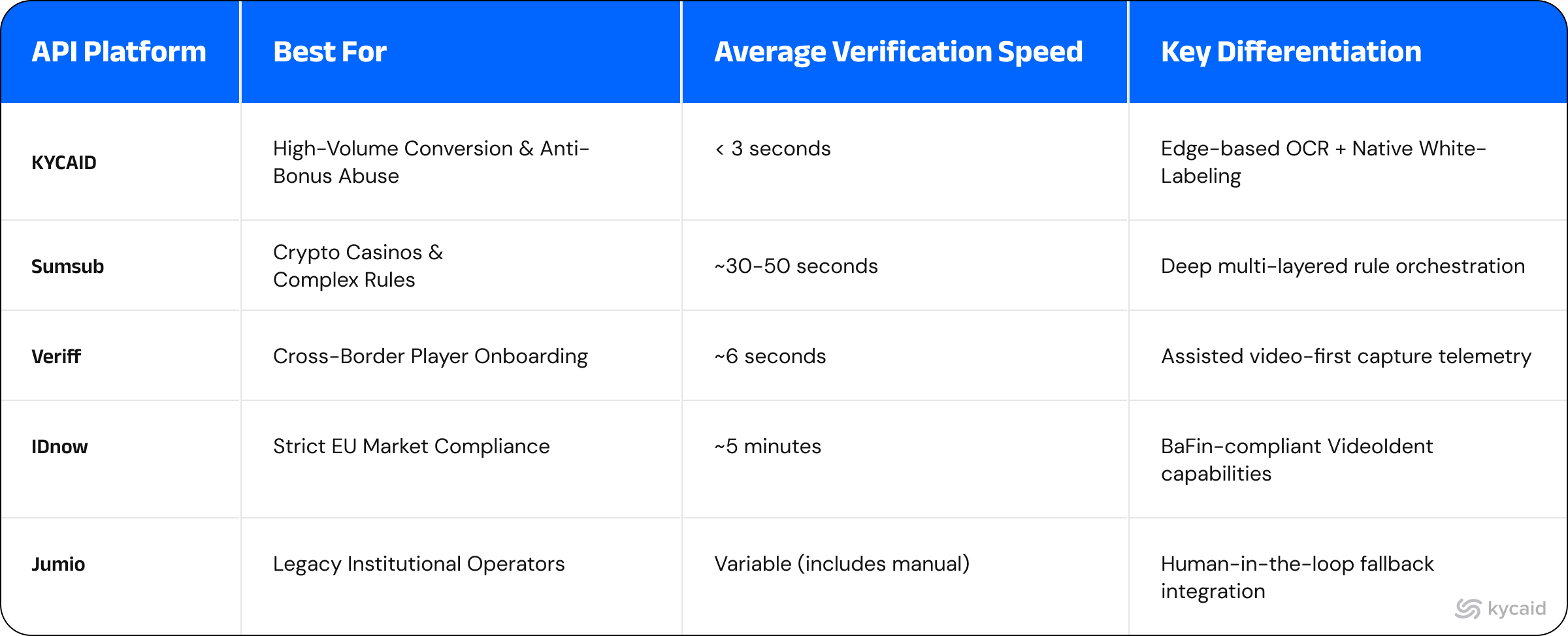
Executive Summary: Top KYC APIs Evaluated
Top KYC APIs Evaluated
KYCAID – Best for Developer Experience (DX) & Rapid Integration
KYCAID treats identity verification as a developer-first microservice. It collapses the complexity of global compliance into a single, unified REST API endpoint. Whether you are pinging a corporate registry for KYB or verifying a retail user's passport, KYCAID handles the entire logic tree and returns a definitive, binary webhook.
Core Entities & Tech Specs:
Biometrics & Extraction: iBeta Level 2 Passive Liveness and Edge-based OCR.
Architecture: REST API with strictly typed JSON responses and idempotent webhooks.
Latency & SLA: Sub-3-second processing latency backed by a 99.99% Service Level Agreement (SLA).
Integration: Ultra-lightweight, native Web, iOS, and Android SDKs.
Pros & Cons:
Pros: Flawless, interactive API documentation. Developers can deploy the fully white-labeled SDK and test sandbox webhooks in an afternoon. The Edge-OCR minimizes server payload size, drastically reducing timeout errors.
Cons: Purely cloud-native; not designed for on-premise, air-gapped server deployments required by defense contractors.
Stripe Identity – Best for Stripe Ecosystem Native
Built directly into the core Stripe infrastructure, Stripe Identity allows engineering teams to seamlessly bind identity verification directly to billing, payment intents, and chargeback protection mechanisms.
Core Entities & Tech Specs:
Architecture: Native Stripe API integration.
Biometrics & Extraction: Auto-capture SDK with automated machine learning analysis.
Integration: Deployed alongside Stripe.js.
Pros & Cons:
Pros: Zero friction if your backend is already built on Stripe. Identity data shares the same unified dashboard as your payment routing, simplifying FinOps workflows.
Cons: Severe vendor lock-in. It lacks the modular flexibility needed if you require complex, standalone Continuous AML Monitoring outside of a strictly payment-driven context.
Veriff – Best for Video-First Verification
Veriff relies on a robust, video-centric SDK. Instead of static images, it captures a burst of video frames and environmental device telemetry to authenticate users against sophisticated presentation attacks.
Core Entities & Tech Specs:
Architecture: REST API with asynchronous webhook callbacks.
Biometrics & Extraction: Active and passive video capture analysis.
Integration: Mobile SDKs and Web integration.
Pros & Cons:
Pros: Exceptional at detecting physical document tampering and deepfakes via continuous video telemetry.
Cons: The video-first SDK is inherently heavier. It requires higher user bandwidth, slightly increasing integration complexity, native app payload size, and potential latency in poor network conditions.
Persona – Best for Modular Infrastructure
Persona offers a "blocks-based" architecture. It provides a visual workflow engine that allows product managers to map out conditional logic and fallback routes before the developers even call the API.
Core Entities & Tech Specs:
Architecture: REST and GraphQL API support.
Biometrics & Extraction: Configurable active and passive liveness modules.
Integration: Pre-built UI components and API orchestration.
Pros & Cons:
Pros: GraphQL support allows engineers to query exactly the data they need, preventing over-fetching. The visual rule engine is excellent for dynamic risk escalation.
Cons: The API logic can become highly convoluted. Debugging complex, multi-layered rule trees deployed by non-technical product managers can be frustrating for the engineering team.
Onfido – Best for Legacy Enterprise Stack
Onfido is a deeply entrenched API relied upon by large banks and legacy financial institutions. It utilizes extensive historical datasets, trained over a decade, to power its document parsing models.
Core Entities & Tech Specs:
Architecture: REST API.
Biometrics & Extraction: Atlas AI engine for facial matching and server-side document parsing.
Integration: Enterprise-grade SDKs.
Pros & Cons:
Pros: Highly trusted by conservative risk departments and regulators; provides deep out-of-the-box reporting endpoints.
Cons: Legacy API architecture can be sluggish. Server-side heavy processing often results in higher Mean Time to Recovery (MTTR) during outages and slower overall integration times compared to modern edge-first APIs.
Buyer's Guide: Evaluating KYC API Architecture
When evaluating an identity infrastructure provider, engineering teams must look past the marketing layer and audit the underlying tech stack using three strict criteria:
- 1. Developer Experience (DX) & Documentation: It does not matter how sophisticated the AI is if the API documentation is fragmented. Look for platforms that offer interactive API references, Postman collections, clear error codes, and a robust sandbox environment that mimics production exactly.
- 2. Webhook Reliability & Idempotency: KYC processing is inherently asynchronous. Your system requires robust, idempotent webhooks. The API must guarantee delivery, provide cryptographic webhook signatures for security, and feature clear retry logic for when your server drops a payload.
- 3. Latency & SDK Weight: To preserve conversion rates, the API must execute Edge-based OCR and liveness checks in under 3 seconds. Furthermore, the SDK should be lightweight; it must not bloat your native app size, conflict with existing dependencies, or aggressively drain user device batteries.
FAQ: Integrating KYC APIs
What makes a KYC API developer-friendly?
A developer-friendly KYC API provides strictly typed JSON payloads, comprehensive and interactive documentation, a robust testing sandbox, and clear, descriptive error codes. It abstracts the complexity of compliance into simple, predictable RESTful endpoints.
How do webhooks function in a KYC pipeline?
Webhooks provide asynchronous, server-to-server communication. When a user completes their biometric liveness check on the client side, the KYC API instantly pushes a secure JSON payload to your server's webhook endpoint, updating the user's verified status in your database without requiring continuous polling.
How to minimize latency in identity verification APIs?
Minimize latency by deploying Edge-based OCR, which processes document extraction directly on the user's device rather than the server. Combine this with iBeta Level 2 Passive Liveness, which requires analyzing only a single frame, drastically reducing the payload size sent over the network to under a few kilobytes.