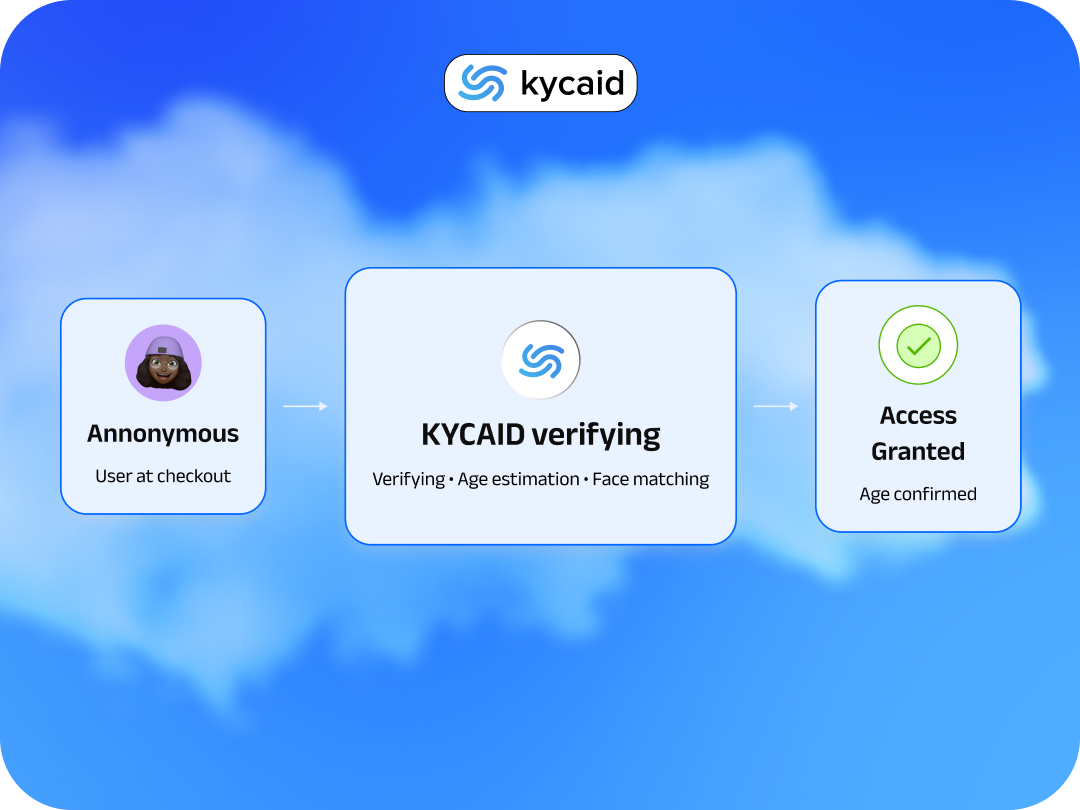
The regulatory grace period for online alcohol retailers is over. For years, D2C beverage brands and alcohol marketplaces operated on a fragile compliance model: using a self-certification pop-up on the website and hoping the gig-economy delivery driver actually checked the customer's ID at the door.
Regulators across the US, UK, and EU have systematically dismantled this loophole.
Today, if your platform processes a transaction for a minor, the legal liability no longer falls solely on the delivery driver; it falls directly on your backend infrastructure. Selling age-restricted goods online now requires a biometrically verified proof of age before the payment gateway captures the funds. If your engineering team has not integrated a synchronous Age Verification (AV) pipeline directly into your checkout flow, you are actively risking massive fines, payment processor bans, and the revocation of your liquor license.
The Legal Death of "Age Gating" and Driver Checks
A simple "Age Gate"—a pop-up asking the user to click “Yes, I am over 21” or manually enter their date of birth—is legally worthless. Regulators classify this as self-declaration, not verification. It provides zero legal cover during an audit.
Outsourcing your compliance to third-party delivery drivers is a catastrophic operational risk. Gig workers are incentivised by speed and delivery volume, not strict compliance. Studies and sting operations consistently show failure rates of over 40% when relying on manual ID checks at the door.
Beyond police fines, there is a more immediate threat: Payment Gateway Bans. Alcohol sales fall under high-risk Merchant Category Codes (MCC). If processors like Stripe or Adyen detect that your platform lacks robust pre-purchase age verification, they will terminate your merchant account, instantly shutting down your revenue stream.
Architecting the Checkout Compliance Pipeline
You cannot wait until the product is dispatched to verify the buyer. The AV process must sit directly in the critical path of the transaction.
Legacy Delivery Checks vs. Digital POS Verification
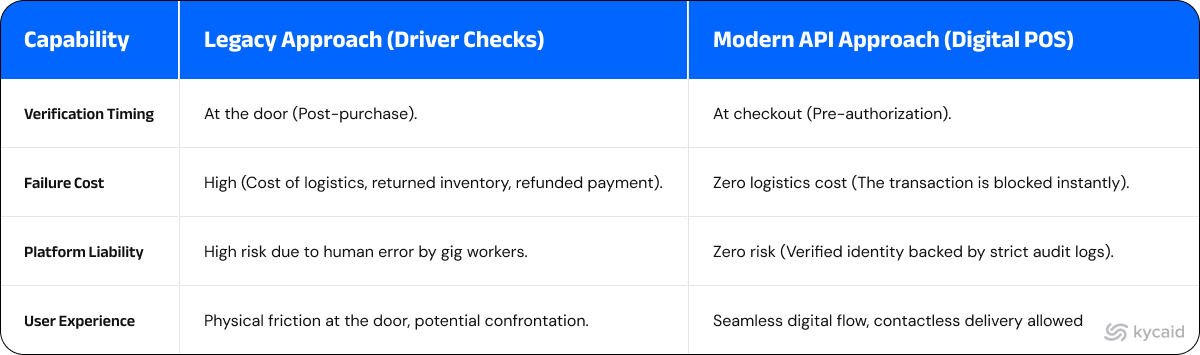
If your backend allows a credit card to be charged before an ID is validated, you are creating a massive logistical headache. An underage buyer completes the purchase, the product ships, and if the driver does catch them at the door, your platform absorbs the cost of the failed delivery, the refund processing fees, and the inventory restock.
A modern architecture requires Synchronous API Validation. The user uploads their ID, the backend validates the Date of Birth (DOB) via Optical Character Recognition (OCR), authenticates the document, and verifies liveness. Only when the AV API returns a 200 OK status with a verified age payload does the checkout logic proceed to charge the credit card.
Solving the Conversion Killer: Speed vs. Compliance
The biggest pushback from e-commerce managers against digital Age Verification is cart abandonment. If checking an ID takes three minutes, the user will leave.
This is an engineering problem, not a regulatory one. Legacy AV tools force users out of the checkout flow, redirecting them to clunky third-party apps. Modern APIs execute the entire process in-line within the browser or native app. By utilising edge-based processing and optimised machine learning models, OCR data extraction and biometric liveness checks can now be completed in under 3 seconds.
The KYCAID Solution: Frictionless Age Verification
KYCAID's Age Verification API is engineered specifically for high-volume e-commerce and restricted goods marketplaces. We eliminate the compliance risk without destroying your conversion rates.
Our SDK embeds seamlessly into your existing checkout flow. When a user attempts to buy alcohol, KYCAID instantly captures their government-issued ID and performs an iBeta Level 2-certified 3D liveness check — both enhanced with AI-powered age estimation. This dual-layer approach not only confirms real-time presence and blocks spoofing attempts, but also cross-verifies that the user's facial biometrics match the claimed age on the document, catching mismatches that traditional OCR alone would miss. We don't just read the Date of Birth; we forensically analyse the document for tampering and ensure the person holding the phone matches the ID.
For returning customers, biometric authentication enables fast, frictionless re-verification — no need to rescan documents on every purchase — while age estimation continues to validate that the same verified adult is completing the transaction.
We deliver a clean, binary JSON payload to your backend via webhook callback in under a minute (e.g., {"is_over_21": true}). Your platform uses this result to allow or block the checkout based on your own business rules, and retains an immutable, auditable log proving you complied with all local age-restriction laws.
Stop relying on gig workers to protect your revenue. Schedule a meeting with our specialists and secure your checkout flow today.
FAQ
Is "Age Gating" (asking the user if they are 21) legally compliant?
No. Self-declaration pop-ups or date-of-birth entry forms do not constitute legal age verification. Regulators require strict verification of a government-issued ID to prevent the sale of alcohol to minors.
Why is relying on delivery drivers to check IDs dangerous?
Delivery drivers are prone to human error, rush to complete routes, and often fail to spot fake IDs. If a driver delivers alcohol to a minor, the e-commerce platform that processed the sale is held legally liable, facing severe fines and payment processor bans.
How does checkout Age Verification impact cart conversion?
While poorly implemented AV can cause drop-off, modern API-driven verification happens in-line within the checkout flow. Using advanced OCR and biometric liveness, KYCAID verifies age in under 3 seconds, maintaining high compliance and low cart abandonment.