
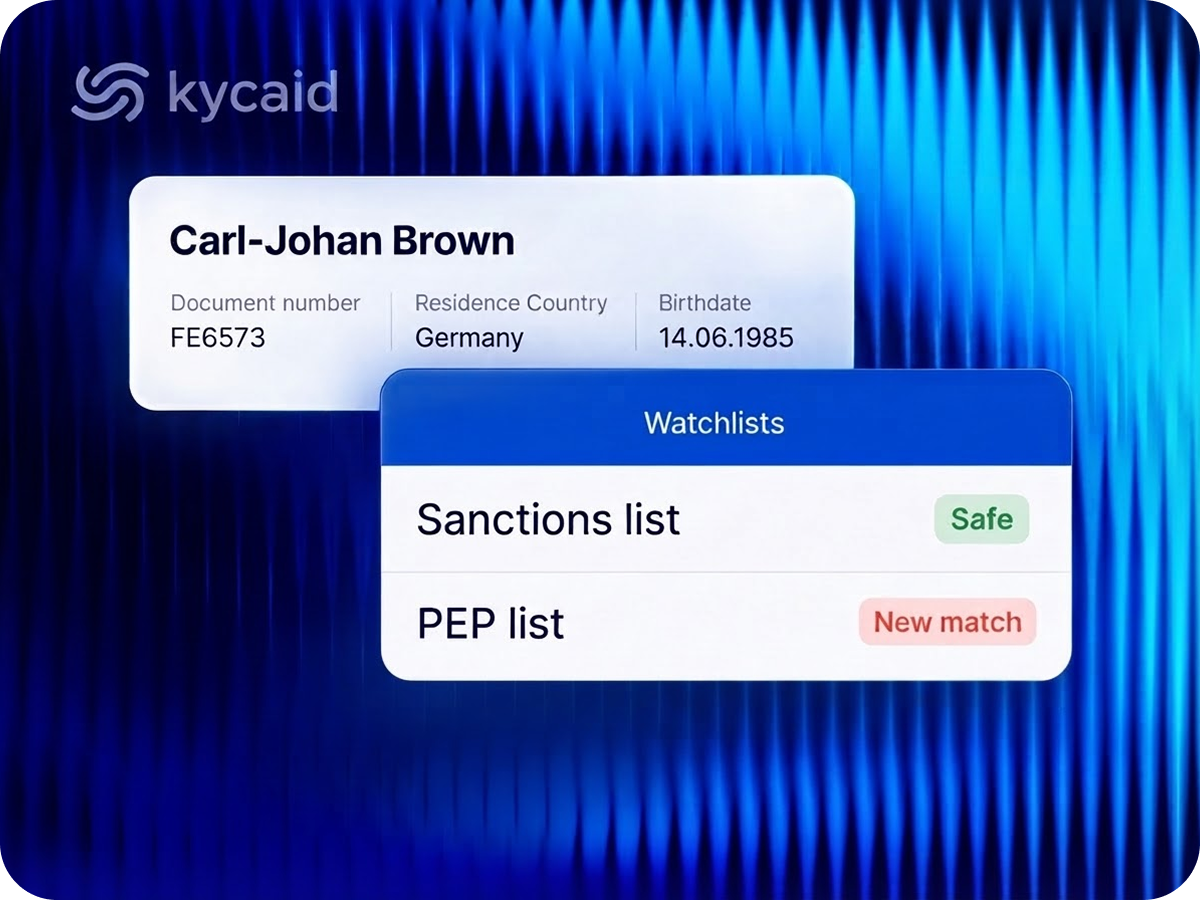
KYC screening is the part of customer due diligence where you compare a verified identity against lists of people you are not allowed to serve, or must serve with extra caution: sanctions lists, politically exposed persons (PEP) registries, law enforcement watchlists, and adverse media. Identity verification tells you who someone is. Screening tells you whether that answer is a problem.
The two get conflated constantly, so it is worth being precise. Screening a fake identity is a waste of money; the name you screened does not belong to the person you onboarded. That is why screening comes after document and biometric checks in any sane workflow, and why it sits inside the broader discipline of customer due diligence.
What lists you are actually checking
◇Sanctions lists. The non-negotiables. OFAC's SDN list in the US, the EU consolidated list, the UN Security Council list, and national lists like the UK's OFSI. A true match here is not a risk signal, it is a prohibition. You cannot onboard the customer, and in most jurisdictions you must report the attempt.
◇PEP registries. Politically exposed persons: senior officials, their families, and close associates. Being a PEP is legal. Serving one is legal. But regulators require enhanced due diligence, because public office plus private banking is history's most reliable corruption recipe. PEP status means more questions, typically including source of funds, not a rejection.
◇Watchlists. Interpol notices, national law enforcement lists, and regulatory disqualification registers. Severity varies by list; your policy should say which lists block and which escalate.
◇Adverse media. News coverage linking a person to fraud, laundering, or other financial crime, often years before any official list catches up. Automated adverse media checks use fuzzy matching and relevance scoring to separate "this John Smith was convicted of fraud" from the other forty thousand John Smiths.
The false positive problem
Screening's practical challenge is not missing bad actors. It is drowning in matches that are not your customer. Common names, transliterated names (Mohammed, Muhammad, Mohamed), and partial data all generate hits.
Three settings decide whether your team spends its day on real risk or on noise. Matching logic: exact-match misses transliterations, while naive fuzzy matching flags everyone; you want configurable thresholds using name plus date of birth plus nationality. List scope: screening a domestic retail customer against every municipal list on earth manufactures work. And disposition rules: documented, consistent criteria for clearing a false positive, because "the analyst felt it was fine" does not survive an audit.
A well-tuned setup pushes false positives down dramatically without loosening true-match detection. If your reviewers clear more than nine of every ten hits as noise, tune the matching before you hire another reviewer.
Screening once is not screening
The most common audit finding in this area is stale screening. Lists change daily; the customer you screened in March may appear on a sanctions list in June. Regulators expect ongoing screening: your entire customer base re-checked against list updates automatically, with new hits routed to review.
That is the argument for continuous database screening rather than point-in-time checks: re-screening runs on every list update, and your customer file stays current without anyone remembering to run it.
What regulators expect you to document
For each screening event: which lists, which matching settings, what the raw results were, who dispositioned any hit and why, and when. For your program overall: a written policy tying screening scope to customer risk. The pattern in enforcement actions is consistent: firms rarely get fined for a single miss, they get fined for being unable to show a functioning system.
FAQ
🔹What is the difference between KYC screening and KYC verification? Verification proves an identity is real and belongs to the applicant. Screening checks that verified identity against sanctions, PEP, watchlist, and media data. Verification first, screening second.
🔹Is PEP screening mandatory? In effectively all AML-regulated jurisdictions, yes. FATF recommendations require identifying PEPs and applying enhanced due diligence, and national laws implement this in the US, EU, and UK.
🔹How often should customers be re-screened? Best practice is continuous: automatic re-screening whenever the underlying lists update. Where that is not possible, risk-based periodic screening, with high-risk customers checked most frequently.
🔹What should we do on a sanctions match? Confirm it is a true match, freeze the relationship per your policy, and file the required report with your regulator. Do not tip off the customer. Your compliance policy should script these steps in advance.