

The operational paradox for PropTech platforms, Title Companies, and Real Estate Investment Trusts (REITs) is absolute: you must clear High-Net-Worth Individuals (HNWI) and complex corporate entities for million-dollar transactions without delaying the escrow process.
Real estate remains the primary vehicle for global money laundering. Under stringent FinCEN rules in the US and the 6th Anti-Money Laundering Directive (AMLD6) in the EU, relying on manual PDF reviews to map Ultimate Beneficial Owners (UBOs) or verify Source of Funds (SoF) is an architectural failure. Manual compliance bottlenecks destroy client experience and jeopardize closing timelines.
In 2026, Chief Compliance Officers (CCOs) and MLROs must deploy identity infrastructure that programmatically transitions from individual KYC to deep corporate KYB, executing AML screening in milliseconds. Here is the technical evaluation of the top five KYC tools engineered specifically for high-value real estate transactions.
Executive Summary: Top Real Estate KYC APIs Evaluated
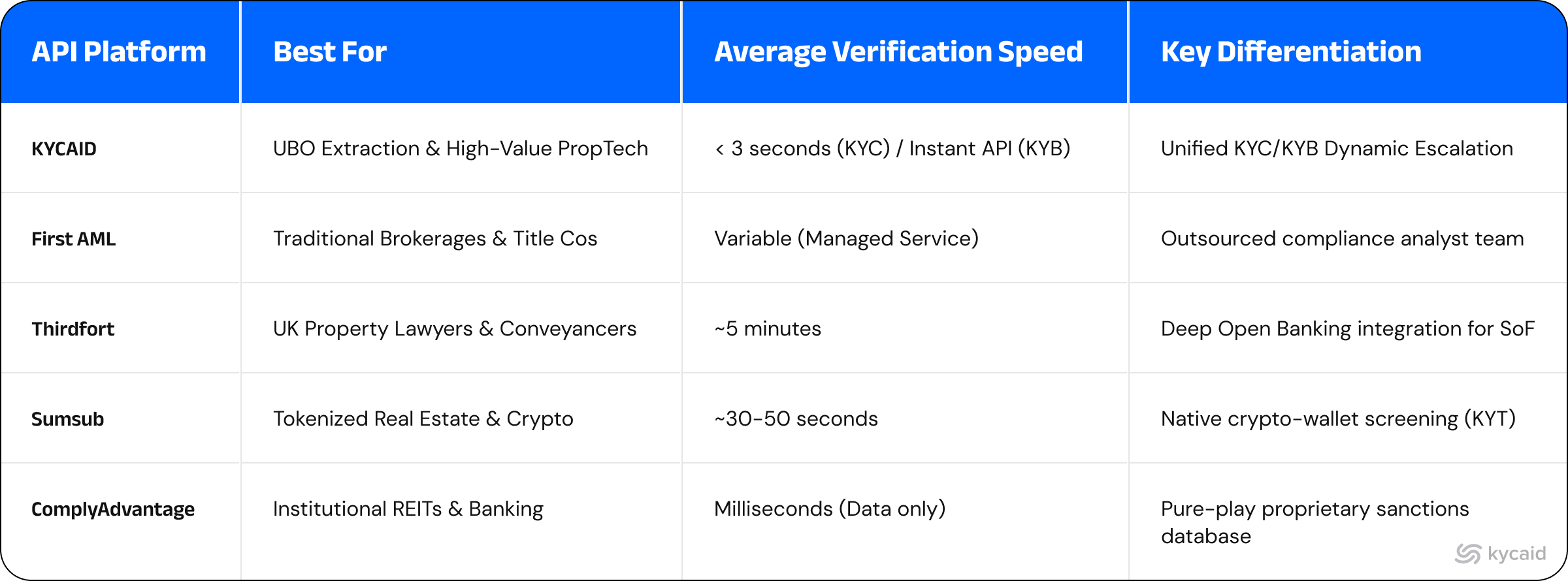
Top Real Estate KYC APIs Evaluated
KYCAID – Best for UBO Extraction & High-Value PropTech Transactions
KYCAID collapses the fragmented real estate compliance lifecycle into a single API endpoint. It is architected to handle the hybrid nature of real estate purchasing, automatically shifting from verifying a retail buyer's passport to mapping the UBOs of an offshore shell company attempting to buy commercial property.
Core Entities & Tech Specs:
Biometrics & ID: iBeta Level 2 Certified Passive Liveness with Edge-based OCR.
Corporate Verification (KYB): Automated corporate registry extraction, UBO mapping, and director screening.
Financial Checks: API-driven Source of Funds (SoF) and Proof of Address (PoA) OCR parsing.
Integration: REST API, Webhooks, and fully white-labeled Web/Mobile SDKs.
Pros & Cons:
Pros: Unmatched ability to execute Dynamic Risk Escalation. If a retail user suddenly initiates a $5M transaction, KYCAID's engine automatically triggers EDD (Enhanced Due Diligence) and Continuous AML Monitoring without requiring a new integration. Zero integration friction for PropTech developers.
Cons: Purely software-driven; does not provide an outsourced team of lawyers to manually call international registries if API data is unavailable (unlike heavy managed services).
First AML – Best for Traditional Brokerages & Title Companies
First AML operates as a B2B managed service rather than a pure-play API. It is designed for legacy real estate agents, venture capital, and title companies that want to completely outsource the collection of complex entity structures and trust documents.
Core Entities & Tech Specs:
Architecture: Cloud-based platform with heavy human-in-the-loop processing.
Corporate Verification: Manual and semi-automated unraveling of complex trusts and holding companies.
Integration: Web dashboard and API.
Pros & Cons:
Pros: Excellent for offline, legacy real estate transactions where buyers are resistant to automated mobile SDKs and prefer uploading PDFs via secure email portals.
Cons: High latency and high Cost Per Verification (CPV). Relying on human analysts to map UBOs means verification can take days, which is unacceptable for instant, digital-first PropTech platforms.
Thirdfort – Best for UK Property Lawyers & Conveyancers
Thirdfort dominates the UK conveyancing market by combining standard ID verification with deep Open Banking integrations, allowing property lawyers to programmatically verify where a buyer's deposit originated.
Core Entities & Tech Specs:
Financial Checks: Open Banking API for automated Source of Funds (SoF) reports.
Biometrics: Mobile-first active liveness and NFC passport reading.
Integration: Standalone consumer app and B2B API.
Pros & Cons:
Pros: The Open Banking integration is a massive time-saver for UK lawyers tracking deposit trails directly from the buyer's bank account.
Cons: Highly localized to the UK and EU regulatory frameworks. The requirement for the buyer to download a third-party app introduces significant UX friction compared to native, embedded SDKs.
Sumsub – Best for Tokenized Real Estate & Crypto
As real estate assets become tokenized on the blockchain, Sumsub provides an orchestration platform capable of linking traditional fiat identity with crypto-wallet risk scoring.
Core Entities & Tech Specs:
Architecture: Visual rules engine and multi-layered orchestration.
Financial Checks: Know Your Transaction (KYT) for crypto deposits.
Integration: Web/Mobile SDKs and REST API.
Pros & Cons:
Pros: Indispensable for Web3 real estate platforms where buyers purchase fractionalized property using stablecoins, requiring deep on-chain analytics.
Cons: The expansive compliance dashboard and continuous monitoring alerts can create a high volume of false positives, increasing the operational burden on the MLRO.
ComplyAdvantage – Best for Institutional REITs & Banking
ComplyAdvantage is not a document capture SDK; it is a massive, real-time proprietary database of global sanctions, Politically Exposed Persons (PEPs), and adverse media. It is the data engine that powers institutional risk decisions.
Core Entities & Tech Specs:
Architecture: RESTful Data API.
AML Screening: Real-time continuous monitoring (pKYC) against OFAC, UN, and global watchlists.
Integration: Direct API integration into existing backend CRMs.
Pros & Cons:
Pros: The gold standard for sheer data volume and fuzzy-matching logic for institutional risk management.
Cons: It only handles the data screening side. PropTechs must still procure, integrate, and maintain a separate vendor for biometric ID capture and document OCR, creating architectural bloat.
Buyer's Guide: How to Evaluate Real Estate KYC APIs
When architecting a compliance pipeline for high-value asset transfers, CTOs and FinOps leaders must audit vendors on three strict criteria:
- 1. Unified KYC to KYB Architecture: Real estate deals frequently involve individuals hiding behind corporate veils. Your API cannot treat B2C and B2B as siloed systems. The infrastructure must support automated UBO extraction and automatically screen the natural persons behind the holding company via a single webhook payload.
- 2. Automated SoF & SoW Parsing: Regulatory fines in real estate stem from failing to prove the origin of money. The API must support Edge-based OCR capable of extracting and structuring data from utility bills, tax returns, and bank statements without requiring manual data entry from your compliance team.
- 3. Continuous AML Monitoring (pKYC): Escrow periods can last 30 to 90 days. A buyer who is clean on day one may be added to a sanctions list on day 45. The API must support Perpetual KYC, automatically pinging your webhook if a party's risk status changes before the deal closes.
FAQ: Real Estate KYC & AML Compliance
Why is UBO identification critical in real estate KYC?
Criminal networks routinely purchase high-value real estate using anonymous shell companies, trusts, or LLCs to launder illicit funds. Identifying the Ultimate Beneficial Owner (UBO)—the actual human controlling the entity—is mandated by AMLD6 and FinCEN to expose hidden risk and prevent regulatory penalties.
How do APIs automate Source of Funds (SoF) checks?
Modern compliance APIs automate SoF checks by combining Open Banking integrations (to digitally verify bank account histories) with advanced Optical Character Recognition (OCR) to instantly parse, extract, and validate data from uploaded tax returns, payslips, and investment statements.
What are the FinCEN and AMLD6 requirements for PropTech platforms?
PropTech platforms facilitating property transactions must implement strict Customer Due Diligence (CDD), verify the identities of buyers and sellers, conduct Enhanced Due Diligence (EDD) on Politically Exposed Persons (PEPs), and report suspicious transactions to financial intelligence units like FinCEN (US) or local European authorities (AMLD6).