
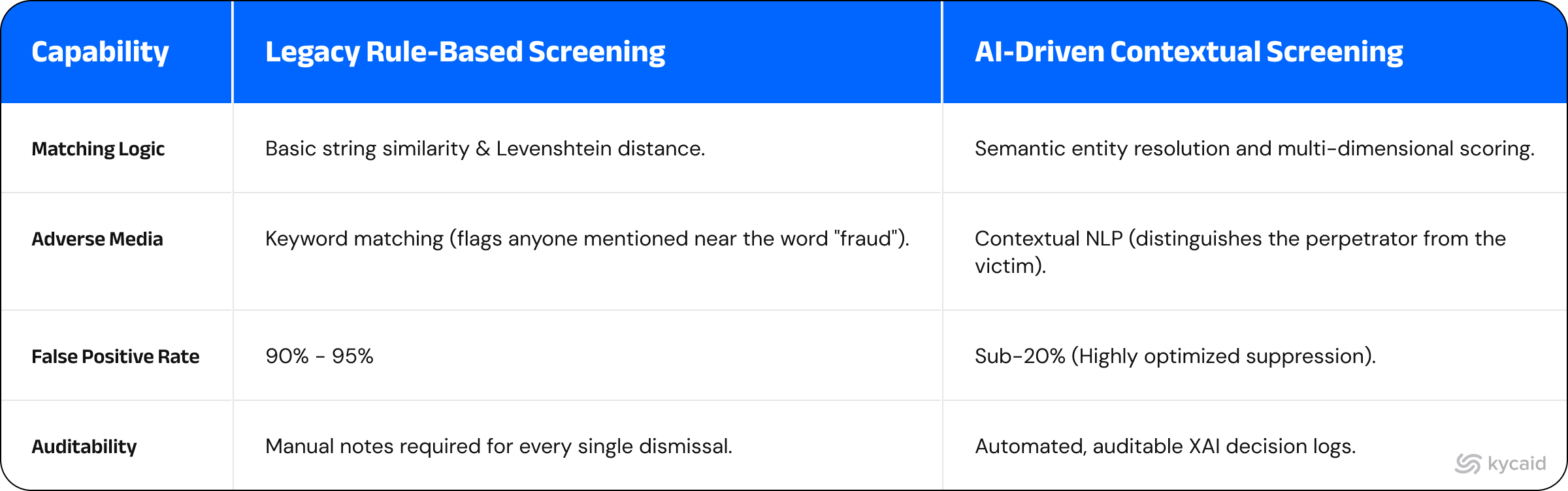
If your compliance pipeline relies on legacy Anti-Money Laundering (AML) architecture, your team is likely drowning in noise. Standard industry systems currently operate at a catastrophic 90% to 95% false-positive rate.
This structural failure effectively turns highly paid Money Laundering Reporting Officers (MLROs) into manual data-entry clerks. When every minor name collision triggers a hard block, the operational costs skyrocket. At an average operational cost of $15 to $50 per manual alert review, a high-growth Fintech or iGaming platform is literally burning thousands of dollars a week just to dismiss irrelevant warnings.
To scale compliance without linearly scaling your headcount, you must fundamentally change how your backend processes identity data.
The Anatomy of an AML False Positive
A false positive is not a random glitch; it is a symptom of a system's inability to process identity context.
The "Name Collision" Trap
Most legacy platforms are built on outdated "fuzzy matching" logic, rooted in basic Levenshtein distance algorithms. This works for catching typos in an isolated database, but it collapses when screening against massive global datasets like OFAC, UN Sanctions lists, or FATF watchlists.
If your onboarding API processes a user named "John Smith," a basic algorithm will flag hundreds of hits based solely on string similarity. It ignores secondary metadata. For a backend engineer, this is the equivalent of querying an unindexed database without filters: you trigger a massive data dump that requires a human to sort through the wreckage.
The Hidden Threat: Alert Fatigue & False Negatives
When 95 out of 100 alerts are garbage, analysts suffer from Alert Fatigue. Their cognitive load maxes out, creating a dangerous psychological environment where they rubber-stamp approvals.
This leads to the ultimate compliance nightmare: the False Negative. An exhausted analyst, blinded by thousands of irrelevant alerts, accidentally dismisses a True Positive (an actual sanctioned entity or money launderer). Alert fatigue doesn't just burn your operational budget; it actively jeopardizes your operating license.
How Explainable AI (XAI) Fixes the AML Pipeline
Applying machine learning to compliance is a strict regulatory challenge. Regulators do not accept "Black Box" algorithms. If your backend automatically suppresses a potential OFAC match, your MLRO must be able to prove exactly why that decision was made during an audit.
Explainable AI (XAI) provides a transparent, auditable logic trail for every programmatic decision, displaying the exact parameters that led to an alert's suppression.
Legacy Screening vs. Contextual AI
Contextual NLP (Natural Language Processing)
Legacy adverse media screening relies on Boolean logic. It generates massive false positives because it flags everyone mentioned in a text—the fraudster, the victim, and the presiding judge.
Modern NLP engines parse semantic context. By analyzing syntax, an NLP model understands the contextual role of the individual. If your user "John Smith" is flagged in a news article, the NLP model determines his role. If he was the victim of the crime, the AI instantly suppresses the alert, keeping your manual review queue completely clean.
Dynamic Risk Scoring
Dynamic risk scoring replaces rigid IF/THEN statements with probabilistic models. Instead of relying on a single name match, the AI automatically ingests and cross-references secondary metadata:
- 🔹 Date of Birth (DOB)
- 🔹 Citizenship and Geolocation
- 🔹 Ultimate Beneficial Owner (UBO) structures
If a newly registered user triggers an OFAC name collision, but the system dynamically calculates that the user's DOB is off by 25 years and their IP geolocation does not match the sanctioned entity's profile, the algorithm automatically scores the alert below the human-intervention threshold.
The Kycaid Approach: Smart Screening Without the Noise
Kycaid’s AML engine is engineered to resolve the false positive crisis programmatically. We don't just alert your team; we resolve the noise at the infrastructure level.
When a user profile enters our continuous monitoring pipeline, our engine automatically enriches the data payload. We actively seek secondary attributes to instantly resolve name collisions before they trigger an alert. By filtering out the vast majority of statistical noise before it ever hits your compliance dashboard, your MLROs are finally freed from manual data entry.
Stop wasting engineering bandwidth and compliance payroll on false positives.
Upgrade your AML compliance pipeline with Kycaid.
FAQ
What is a false positive in AML screening?
A false positive occurs when a compliance system incorrectly flags an innocent user as a high-risk entity (such as a sanctioned individual or a PEP). This typically happens due to "name collisions," where a legitimate user shares a similar name with someone on a global watchlist.
How does AI reduce false positives in sanctions screening?
AI reduces false positives through dynamic risk scoring, which compares secondary metadata (like DOB and citizenship) against the flagged entity. It also utilizes Natural Language Processing (NLP) to understand the actual context of adverse media, automatically suppressing irrelevant alerts.
Will regulators accept AI for AML compliance?
Yes, but strictly if the AI is Explainable (XAI). Financial regulators require compliance decisions to be fully auditable. The system must provide a transparent logic trail detailing exactly which data points and weights led to an alert being suppressed or escalated.